

by Ron Raskin.
In one of my earlier posts, I described the main ideologies in today’s West and the thinking behind them. Now I want to focus on one of them: the social-progressive such as represented by current Spanish government and their vision which is based on belief that the West should “lead by moral example.” But what does that actually mean today? Does it mean improving yourself and following your own moral rules — or does it mean trying to force others to follow the “good” as you define it?
Unfortunately, in practice it is usually the latter. Instead of self-reflection and ensuring they genuinely follow their own rules, many prefer to impose their version of “good” on others.
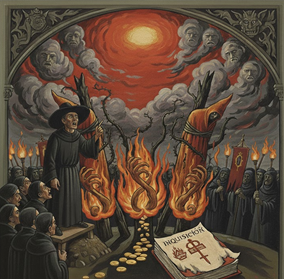
History has seen this pattern again and again. Medieval Europe had the Spanish Inquisition, which sought to ensure that “good” triumphed over “evil” — and became, unsurprisingly, a symbol of cruelty and darkness. The expulsion of the Jews from Spain in 1492 was likewise carried out in the name of “moral purification.” The Third Reich murdered six million Jews and one million Roma, also in the name of a supposed moral ideal. Killing in the name of “morality” — what could possibly be more immoral than that?
And yet, prophets of moral absolutism keep reappearing throughout human history. Sometimes in milder forms but regardless of their tone, such crusades rarely bring real good to the world.
And today, once again, we should be worried because moral crusades usually end with bloodshed — not the blood of evil people, but of people who are simply different. When the world becomes unstable, people easily lose their sense of reality. They start confusing black and white and fall prey to such movements. It is astonishing how quickly people can lose their moral compass and embrace the unthinkable.
We saw it a century ago, when Hitler — after a failed putsch that violated the most basic norms of society — managed to rise to power while preaching from the very courtroom judging him for that crime. And we see a similar blindness today, when Hamas — which murdered children and raped women — is celebrated and defended by people who claim to speak in the name of morality. All of it justified by some “higher purpose” that is supposed to excuse any cruelty. And on November 4th, when the people of New York were asked whether they could accept and even glorify this, their answer was loud and clear: “Yes, we can!”.
And here we are again: witnessing a new “prophet” of morality embodied by the mainstream progressive movement, expelling Jews from “Spain” once more, persecuting them across Europe, crucifying them in the information space. This movement insists that it would be moral for Jews not to defend themselves — to give up, assimilate, and disappear — to become sacrifices on the altar of peace and progress. It insists that the truly moral act would be to carry out what is, in fact, a real genocide: “the persecution of a large number of people from a particular national or ethnic group with the aim of destroying that nation or group.”
So, as we’ve seen, “leading by moral example” often turns into a moral crusade against others. But that still leaves another question: what is the core idea behind this crusade, and how do they justify it logically?
The core progressive idea is that we should be very supportive and patient toward failing societies, even when they are extremely violent, believing that this support will eventually help them move toward progress and democracy. It’s a nice idea, but it doesn’t match reality. Democracy cannot exist without personal responsibility. When people claim that outside forces are to blame for a society’s failures and use that as an excuse for that society’s violence, they are not helping it progress — they are ensuring it will never become a democracy, because they encourage people to look outward and blame others instead of looking inward. In practice, they are simply justifying that society’s violence.
This applies, for instance, to Russia, which blames the West for its problems in the 1990s, and to many Muslim countries that still blame colonialism from almost a century ago. The Palestinians in Gaza are another clear example: despite receiving huge amounts of attention and money for over 30 years, they did not move toward democracy but instead became even more radicalized and violent.
At the same time, there are many historical cases where nations under existential pressure — rather than benefiting from a kind of “affirmative action” — were able to progress and build successful societies. Few nations have suffered over centuries as much as the Jews, with the Holocaust as the peak of that suffering, yet Israel managed to build a democratic and liberal society in a very short historical time. Taiwan is another example of a country that built a strong democracy after enduring major challenges. And today, Ukraine — under existential threat — is striving to deepen its democracy and fight corruption.
This doesn’t mean existential threat is the only path to democracy, nor that support for failing societies is always a bad idea. But these cases do show that pampering can stunt development, while pressure can sometimes drive real progress. And the truth is that we simply don’t know the exact formula for societal progress — and anyone who claims they do is likely just a crook…
Agree with the last paragraph.