

By Ron Raskin.
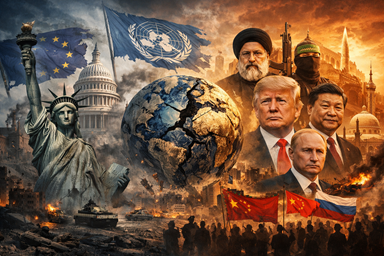
Only the blind cannot see that the old world order has collapsed. Even politicians now admit it. At the recent Munich Security Conference, the German chancellor openly said: “I fear we must put it even more bluntly: this order—imperfect even at its best—no longer exists in that form”
But the real questions are different: What exactly was this old order? Who ended it? Why did it collapse? And what kind of world will replace it? These are the questions now debated across the world, especially in the West.
What Was the Old Order?
The old order was a liberal Western order. By “liberal,” I don’t mean only today’s progressive liberalism, but the broader liberal tradition developed over centuries. Its modern shape goes back to Woodrow Wilson and his Fourteen Points, which later influenced the creation of the League of Nations, the United Nations, the global human rights system, and other international institutions.
The idea was simple and ambitious: nations would follow common rules. Liberal democracies would cooperate and live peacefully together. It was a beautiful dream — but also a naïve one.
Thirty-five years ago, after the Cold War, it seemed that this dream was close to reality. Liberal democracy looked victorious. But like climbers who almost reach the summit and then fall just before the peak, the liberal order collapsed just short of success.
The West and Its Decline
For centuries, the Western world dominated the globe—economically, technologically, militarily, intellectually. It wrote the rules, built the institutions, controlled the seas, shaped global finance, and defined what “modernity” meant.
On its way to building this order, the West defeated rival ideologies such as communism and fascism. Both were not foreign civilizations attacking from the outside. They were Western-born ideologies. Western crises. Western civil wars. The 20th century was not a clash between civilizations—it was a brutal family argument inside one civilization.
And liberalism won. It defeated fascism in 1945. It outlasted communism in 1991. By the early 1990s, it seemed that history itself had taken a side.
But the dream had a blind spot. It assumed that Western dominance was permanent. It wasn’t.
The very power that allowed the West to build the liberal order—its demographic weight, its economic supremacy, its technological monopoly—was already declining.
At the start of the 20th century, Europe (including Russia) made up about 27% of the world’s population. Today it is around 9%. Europe’s share of global GDP fell from nearly 50% to just over 20%. The West is no longer demographically or economically dominant.
As the balance of power shifted, the world order shifted too. Already in the early 1990s, it became clear that the world was moving toward what Samuel P. Huntington called a “clash of civilizations.” The West tried to avoid this clash in different ways:
- Through import of demography (immigration) and multicultural policies.
- Through globalization — importing goods from China while hoping to export Western values back.
- Through military interventions, such as in Iraq and Afghanistan.
- Through moral and ideological campaigns promoting progressive values worldwide.
In the end, these efforts failed.
Enter Trump’s Second Term
When Donald Trump returned to office, it quickly became clear that he did not care about preserving the old world order. His statements about Canada and Greenland, his harsh treatment of President Zelensky in early 2025, his tax policies, his actions regarding Venezuela, and his renewed push to acquire Greenland — all signaled a break from the old system.
Yes, Trump’s actions may be the most visible blows against the old order. But he did not cause its collapse. He did not initiate it.
The order had already collapsed when Russia invaded Ukraine in 2022. It collapsed again when Hamas, backed by Iran and its proxies, attacked Israel in 2023. Anyone who looked honestly at reality could see that the old rules were no longer respected.
Trump’s actions are dramatic and spectacular—but mainly for those who either refuse to see or refuse to accept that the system was already gone. That, in essence, is one of the most important dividing lines between today’s Western right and left political camps—the line that is tearing apart many Western nations today.
The Race for a New Position
We are in the middle of a global transition. Trump simply began positioning the United States for a new place in a new world order. He is acting in three arenas:
- Inside the United States
- Within the West
- On the global stage
Each deserves separate discussion.
On the Global Stage
Actions like pressure on Venezuela openly cross the official rules of the old order. But what is the value of rules that most of the world already ignores?
If international law applies only to Western countries and limits their ability to respond, then it becomes a burden rather than protection. This does not mean the West should abandon its core values. But it does mean that many global institutions — including aspects of globalization and even the United Nations — look outdated.
The faster the West admits this reality, the better chance it has to shape the new system instead of being shaped by it.
Inside the West: The Question of Size
The new world seems to be moving toward large power blocs. Size will matter — and it will be measured in billions:
- China: 1.4 billion
- India: 1.5 billion
- The Muslim world: 2.2 billion
In such a world, small and mid-sized powers risk becoming irrelevant.
Isn’t this why Putin began pushing for Russian expansion? With 140 million people, Russia alone is not in the top league. But neither are the United States, the European Union, the UK, or Japan if they remain fragmented.
The West faces a simple but difficult question: how can it become big enough?
Historically, large empires were built by force. That is the fastest method. Putin is trying that path. Trump, in his own way, also seems to prefer alignment through power — using economic and technological pressure rather than military force.
This creates a kind of modern feudal logic: the U.S. president as central authority, Western allies as semi-autonomous vassals. The problem is obvious: systems built on pressure are unstable. Vassals eventually try to break free. Europe today seems to be reconsidering its dependence.
There is another path: a voluntary federation or confederation of Western nations. But is it too late? After the recent tensions between the US and Europe, is such a long-term project still even possible?
Inside the United States
The same dilemma exists within America itself. The fastest way to unite a divided nation is through centralized power — which often means less democracy and more autocracy. But the risks are clear: deeper divisions, long-term resentment, and political wounds that do not heal easily.
Wouldn’t it be better if the U.S. political left voluntarily closed ranks and, by doing so, ensured both the survival of democracy and a stronger chance for the West to endure and prosper in the new world order? Will the political left — or at least part of it — be able to rise to the moment? Can the political right show enough patience and flexibility to compromise and build a bridge across society? Or will the political right swing to the opposite extreme on its own and drift toward isolationism and separatism?
I leave each reader to answer these questions for themselves…