

By Ron Raskin.
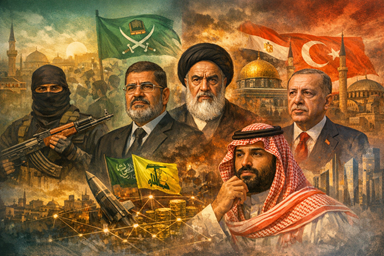
In his famous article “The Clash of Civilizations?”, Samuel P. Huntington predicted much of the world we see today—a world increasingly shaped by deep civilizational tensions and inevitable clashes. The world that we must understand if we want to ensure a future for our children
This is my first post in a short series that maps the ideological landscape of Islamism and explains how it has influenced Western politics over the past few decades to provide context for anyone trying to understand today’s political landscape in the West—with its growing internal tensions, cultural conflicts, and ideological battles. And of course, this discussion would be incomplete without addressing Israel’s place and role within this confrontation.
Introduction
Islamism is not a single ideology but rather a contested space where powerful movements compete to define the “correct” relationship between religion and the state. Historically, three major forces have shaped this arena: Salafism, the Muslim Brotherhood, and Khomeinism (the Shi‘a-based ideology of the Islamic Republic of Iran). Their relationships—shaped by both strict religious beliefs and practical geopolitical interests—form the hidden structure of the modern Middle East.
Recently, however, new players have entered this already complicated pan-Islamist landscape: Erdoğan’s doctrine of Islamic unity and Saudi Arabia’s doctrine of economic cooperation.
Salafism: The Purist Core (and its Paradox)
Salafism is not a political party; it is a powerful religious methodology focusing on the “purification” of Islamic practice. It seeks to emulate the first three generations of Muslims—the Salaf al-Salih (Pious Predecessors)—and rejects any subsequent innovation (Bid’ah) as deviation.
This purism puts them in direct, often violent, conflict with Shi’ism (which they reject as theological heresy). The vast majority of Salafis are “Quietists,” shunning politics to focus on personal piety and obedience to their (often monarchical) rulers. A small part, however, is “Jihadist” (e.g., ISIS/Al-Qaeda), seeking to impose this purity by force.
View on Pan-Islamism: Salafism is, paradoxically, a powerful Religious Pan-Islamism but rarely a political one. They believe all Muslims must follow the same, “pure” creed, yet they do not seek a unified political state. Instead, they typically defer to national boundaries and existing rulers (like the Saudi Monarchy) as legitimate authorities to be obeyed, prioritizing theological unity over political organization.
The Muslim Brotherhood: The Transnational Activists
Founded in Egypt in 1928, the Muslim Brotherhood (MB) is the quintessential political-social movement. Unlike the Salafis, their focus is not just on personal piety but on “Islamizing” the state from the bottom up—through social services, charities, and political activism. Their famous slogan, “Islam is the Solution,” is designed to bypass national borders.
The Brotherhood is highly pragmatic. While they are from the Sunni majority, they prioritize the creation of an “Islamic Order” above theological purity. In early 2026, facing intense suppression from Gulf Monarchies and new U.S. terrorist designation of the Sudanese Muslim Brotherhood, the MB officially abandoned its “neutral” stance and formed a defensive alliance with Iran, its historic “rival.”
View on Pan-Islamism: The MB is the world’s foremost proponent of Transnational Pan-Islamism. Their foundational goal is the creation of a “Caliphate” or a unified political body. In their March 9, 2026 statement they declared that “Current developments clearly demonstrate the necessity for all Arab and Islamic states to prioritize achieving strategic independence—militarily and economically—from any external influence, and to develop mechanisms for coordination and integration among themselves”
View on Democracy: The relationship between the Muslim Brotherhood and democracy is one of the most debated topics in Middle Eastern politics. In the current context of 2026, this relationship is often described by political scientists as “Instrumental”—meaning the group views democratic processes not as an end goal (liberal democracy), but as a tool to achieve an Islamic state.
The Brotherhood’s stance can be broken down into three main phases:
- The “Tactical” Embrace (Pre-2011): For decades, especially in Egypt and Jordan, the Brotherhood participated in elections even when they weren’t fully “legal.” Participation was a way to gain protection from state repression and to “Islamize” society from within the system. During this period, they often allied with secular parties to demand free and fair elections.
- 2. The “Majoritarian” Experiment (2011–2013) : The Arab Spring provided the Brotherhood with its first real taste of power. Following the election of Mohamed Morsi in Egypt (2012), the world saw the Brotherhood’s “majoritarian” view of democracy in action. Once in power, the Brotherhood was criticized for using its 51% mandate to push through a religiously colored constitution without broad consensus. Brotherhood practiced “Illiberal Democracy”—they respected the procedure of voting but ignored the values of democracy, such as protecting minority rights and the separation of powers.
- 3. The 2026 Perspective: “Post-Democracy”: As of March 2026, the Brotherhood’s relationship with democracy has been largely severed by force. Following the 2013 coup in Egypt and recent terrorist designations in the U.S. and across the Gulf, the movement has mostly moved underground. There is a massive internal debate between the “Old Guard” (who still believe in returning to the ballot box) and a younger generation that views the “democratic experiment” as a failure that only led to prison and exile. The group is currently prioritizing “Resistance” over “Electoralism,” forming closer ties with the non-democratic Islamic Republic of Iran to survive.
MB and Jihad: The Brotherhood historically preferred “gradualism” (elections and social work). However, as it can be clearly seen on the Hamas case such social work might easily turn latter to Jihad.
The Islamic Republic of Iran (Khomeinism): The Revolutionary Vanguard
The 1979 Revolution in Iran established a unique theocratic state based on Ayatollah Khomeini’s doctrine of Wilayat al-Faqih (the Guardianship of the Jurist). Khomeinism is not just an ideology; it is the operating system of a sovereign state, an intelligence apparatus, and a powerful, asymmetric military machine.
Under Khomeini’s “Export of the Revolution” directive, Iran seeks to lead a global “Axis of Resistance.” While Shia, they actively cultivate Sunni partners (like Hamas, a Muslim Brotherhood branch) to project power and bypass sanctions. The early March 2026 killing of their supreme leader and the subsequent strikes on Tehran have forced them to rely heavily on the Muslim Brotherhood’s global financial networks (hawala and crypto) to maintain regional influence.
View on Pan-Islamism: Iran practices a state-centric “Resistance Pan-Islamism” (a top down approach). While they do not use the Brotherhood’s “Caliphate” language, they seek a unified regional order where the Islamic Republic acts as the vanguard against Western and Israeli hegemony. Like the Brotherhood, they erase sectarian lines for the sake of political unity.
“Neo-Ottoman” Nationalism and Saudi Arabia’s “Economic Pan-Islamism”
These are not the only visions for the future of the Muslim world. The early 2026 landscape is defined by the rise of a fourth, powerful “counter-axis”: “Neo-Ottoman” Nationalism led by President Erdoğan of Turkey.
Erdoğan offers a “State-Led Pan-Islamism.” In his pivotal March 2026 speech (see the video) , he famously stated, “We have only one religion, and that is Islam,” explicitly calling for the erasure of Sunni-Shia labels. He seeks a unified “Islamic Super-Bloc” (a “Muslim NATO”) of strong nation-states led by a modernized, militarily sovereign Ankara. Erdoğanism is different because it operates within a modernized, state-led G20 economy, competing with Saudi Arabia’s “Economic Pan-Islamism” for regional leadership (which seeks to unify Muslims through a shared interest in profit, technology, and stability rather than a shared revolutionary or puritanical creed).
Summary
There is nothing wrong with people wanting unity. In fact, the European Union shows that such a project can exist without threatening others.
The real question is how that unity is achieved. Will it be built through religious fanaticism, wars, and bloodshed? Or through peaceful economic and cultural cooperation?
That is the key question of 2026. Will political Islam be shaped by the grassroots, “textbook” pan-Islamism of the Muslim Brotherhood, the revolutionary model of Khomeinism, the state-centered vision of Erdoğan’s “Century of Turkey,” or by a more peaceful path based on economic cooperation and growth, as promoted by Saudi Arabia?