

By Ron Raskin
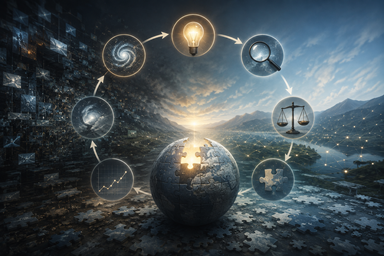
Since the Enlightenment, liberalism and the scientific method have developed side by side, helping humanity achieve unprecedented levels of technology, freedom, and progress. Each, in its own way, has strengthened the other. And today, as the world once again finds itself in a period of profound turbulence, we would do well to return to some of our basic liberal foundations and consider how they can be applied to the challenges of the modern world.
One of those challenges is the media. Journalism and the media are essential foundations of a liberal democratic society. Without a functioning information system, it is difficult, if not impossible, to sustain a functioning democracy—as history has repeatedly demonstrated. Democracy first emerged in the relatively small communities and city-states of the ancient world, where meaningful communication between citizens was possible, only to disappear for many centuries. One reason was the difficulty of sustaining meaningful dialogue across the enormous distances of empires and kingdoms stretching across thousands of kilometers.
Today, we face a somewhat similar challenge, albeit one of a completely different nature: How can a society remain democratic if it lacks a shared and effective foundation for discussing important issues, challenging ideas, and reaching conclusions that most people can accept—or at least understand? Strangely, the abundance of information available to us has not made communication easier. In many ways, it has made it harder. The more information we have, the more we need mechanisms that help us organize it, evaluate it, and turn it into a meaningful conversation.
In the past, people across a country were more likely to encounter the same news and broadly similar interpretations of events. They could respond to and criticize those narratives, and their criticism could then reach much of the same audience that had originally consumed the information. Today, different groups increasingly inhabit separate information environments and echo chambers, effectively becoming disconnected from one another. This creates fertile ground for different political groups to manipulate information and promote their own narratives (and all political groups do this), contributing to increasingly extreme worldviews and dangerous polarization within society.
There are many possible technological and regulatory approaches to addressing the problem and ensuring that our communication systems remain effective. But given the speed of technological development, these approaches are struggling to keep up. Thus, at least for now, it is up to each of us to improve our ability to understand the world, filter out fake news and biased narratives, and preserve our capacity to sustain a functioning democracy. And perhaps it is always a good idea to remember that, ultimately, this responsibility rests with us.
But saying that each person must improve their own ability to understand the world does not solve anything unless everyone has the right set of tools to do so. And this set of tools is science.
The same science that is built on Metaphysical Realism, just as classical liberalism is, synthesizes the foundational ideas of Francis Bacon, John Locke, Isaac Newton, René Descartes, and Karl Popper. It operates as an iterative process through the following core steps:
- Observe a phenomenon to gather empirical data and identify patterns.
- Formulate an explanatory hypothesis to account for the observations.
- Deduce testable predictions from that hypothesis using logical consequences.
- Conduct experiments to deliberately attempt to disprove (falsify) those predictions.
- Refine or reject the hypothesis based on the empirical results.
Our science, our technology, and our progress are built on these principles. The very same principles are also fundamental to modern AI. They are at the heart of how modern AI models are developed, including LLMs such as ChatGPT.
But while we have learned how to apply these principles to science and AI, we have somewhat forgotten to teach ourselves to apply them to information about the world around us in order to understand it.
Scientific Principles to Help Us Read the News
The first principle to recognize is that no one can ever possess a complete picture of the world. This does not mean that objective reality does not exist—it does. Rather, the world is so complex, interconnected, and dynamic that no single person can fully perceive all of its dimensions or systemic implications.
Each of us therefore holds only a piece of the puzzle: an imperfect approximation of one part of a much larger and more complex reality. Collectively, however, we can build a far more accurate understanding of that reality. As discussed earlier, doing so depends on effective communication—something that is unfortunately disrupted by individuals and institutions that deliberately seek to mislead us through propaganda, misinformation, and carefully curated narratives.
This leads to a second important principle: there is no such thing as a completely “trusted” source of information, and the pursuit of information “purity” is itself a trap. Every source has its own limitations, assumptions, biases, and incentives. Treating any individual, institution, or information channel as inherently trustworthy means giving up our responsibility to think critically—and leaves us vulnerable to exploitation by those who control that source.
This makes individual responsibility especially important. Each of us must continuously work to improve our understanding while remaining open to new information—and therefore to different sources and perspectives. We should resist the temptation to dismiss sources simply because they challenge our existing views or come from perspectives we disagree with. Rather than replacing one trusted narrative with another, we should constantly compare sources, examine competing perspectives, question what we believe we know, and revise our views when the evidence warrants it. By doing so, we not only improve our own understanding but also contribute to a more accurate collective understanding of reality
In this sense, the process reflects a foundational liberal principle: when individuals are free and encouraged to pursue a better understanding of the world for themselves, their efforts can collectively contribute to building a better society.
How do we improve this approximation? How do we constantly build a more accurate model of the world in our minds? We do it exactly as we do in the natural sciences, and exactly how we train Artificial Intelligence: through continuous feedback loops. We formulate a hypothesis capable of explaining the data we currently possess, derive testable predictions from it—such as anticipating the strategic moves of politicians or how certain events will unfold—and then continuously repeat the cycle. We must constantly search for hypotheses that fit the shifting data better, predict outcomes more accurately, and adapt. Along the way, we must apply Occam’s razor to ensure we are not drifting into conspiracy theories, and we must ruthlessly refuse to discard evidence simply because it contradicts our current assumptions. In fact, such evidence may be the most important clue we have for discovering reality.
On a practical level, this changes how we view our political adversaries. Every time we observe our opponents saying or doing something that appears utterly mad or irrational, we must resist the lazy temptation to automatically assume they are evil, insane, or stupid—a reaction that merely causes us to wave away vital real-world data. Instead, we must consider an alternative possibility: that our own internal model of the world is simply not sophisticated enough to explain the underlying logic behind our opponent’s words or actions. Only when we fully understand the underlying logic of our opponents—so deeply that we can even empathize with it—can our model of the world become truly accurate.
Yes, there are bad people. Yes, there are bad politicians. But most people are good, and most politicians want to go along with their people.
And yes— “you can fool all the people some of the time, and some of the people all the time, but you cannot fool all the people all the time” (Abraham Lincoln) . Thus, whenever we see many people following a particular idea that we don’t understand and dislike, for a long time, we should also consider the hypothesis that our model of the world is not sufficiently good to explain why this is happening.
Understanding doesn’t necessarily mean accepting. It means that we have improved our own model of the world, perhaps bringing our worldview somewhat closer to that of our opponents or gaining more tools with which to understand and deal with them.
If liberalism begins with the freedom of the individual to think, then perhaps its greatest responsibility is the willingness to question what we think we know. The guidelines above are not a complete method for understanding the world, but rather a practical starting point for applying scientific thinking beyond the laboratory—to the information we consume, the narratives we encounter, and the world we are trying to understand.
But What About Feelings? We Are Human, Not Machines!
Everything above may sound reasonable, but a critical reader might raise an interesting question: if we all have access to the same basic principles of reasoning, why do so many thoughtful and well-intentioned people arrive at radically different conclusions?
The answer is that we are not machines. Our reasoning does not begin with a blank slate. Our feelings influence the assumptions we start with.
Logic allows us to reason from our assumptions, but those assumptions are not universally agreed upon. We choose—or inherit—different starting points from the many possible ways of interpreting the world, often guided by our feelings. In many cases, we are not even aware that we have made these choices. Yet once those underlying assumptions are in place, they shape how we interpret new information and gradually form our worldview.
This is also why effective propaganda often targets our emotions rather than our logic. If you can influence someone’s starting assumptions—what they fear, trust, value, or identify with—you can influence how they interpret everything that comes afterward.
Changing a worldview is therefore not always as simple as following a predefined set of steps. Often, we need an overwhelming amount of evidence to challenge an established worldview. Alternatively, we can go deeper and examine the hidden assumptions underlying our reasoning. This means that we should not only ask, “Is my reasoning correct?” but also, “What am I assuming before I even begin to reason?”
Happy assumption hunting!