

By Ron Raskin.
The MOU signed by Trump was nothing less than a shock across the Israeli political landscape—and not only there. The inevitable question everyone is asking is: why? Why did he sign such a terrible MOU?
It is time to look at reality with our eyes wide open, because in our world, disconnection from reality and misconceptions lead to wrong—and potentially catastrophic—decisions and solutions.
But first, it is worth recalling what was actually achieved during the last few years, and specifically during Operation Rising Lion and Operation Epic Fury. Iran, which was an inch away from crossing the point of no return—a year ago on the nuclear front and only a few months ago on the missile front—was pushed back by several years. In other words, valuable time was bought.
At the same time, the last war exposed a major American and Western weakness: the Strait of Hormuz—or, more precisely, the Western inability to control it effectively. The possibility that Iran might attempt to take control of the Strait of Hormuz was, of course, well known.
It will likely take a year or so to partially overcome this vulnerability by building alternative infrastructure. Even then, the problem will not be fully solved. The Gulf states, due to their geographic proximity to Iran, will remain vulnerable despite any alternative infrastructure. As a result, the entire world that depends on their oil remains exposed to a threat that Iran has effectively taken hostage.
This is, in essence, one of the two main jihadist tactics repeatedly used to force Israeli and Western reactions. The second tactic is to create a threat that becomes increasingly difficult to live alongside, thereby forcing Western countries to act. That was the logic behind 9/11. That was the purpose of the “Ring of Fire” strategy and the October 7 attack. And that was the logic this time as well: the rapidly growing Iranian missile stockpile.
If you do not act, your strategic situation deteriorates. If you do act, you also play directly into Iranian hands by providing an excellent excuse to expand Iranian influence over the Strait of Hormuz and the Gulf states.
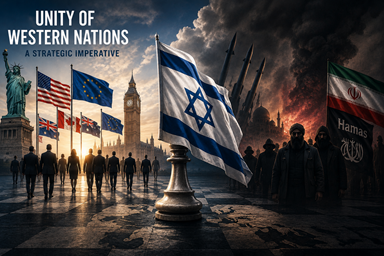
Let’s be honest: the Iranians play chess very well.
As a result, the Trump administration evaluated the available options and found that there were not many good ones. The choices were essentially:
- An invasion to dismantle Iranian military infrastructure, at the cost of thousands of American casualties and hundreds of billions of dollars.
- The destruction of Iranian energy infrastructure, which would likely also lead to severe damage to Gulf energy infrastructure.
- Buying time, preparing for the next round, and hoping that the balance of power will be more favorable when it arrives. Each side believes it can use that time more effectively than the other.
There was, of course, another option: maintaining the blockade on Iran. However, such a strategy appears unstable because Iran clearly signaled its intention to resume military activity, eventually leading back to one of the previously described scenarios.
And so here we are: an agreement signed in Versailles—a blatant reminder that the next round is only a matter of time. And, as in the twentieth century, it may well be bloodier than the first round that began on October 7.
In addition to its immediate geopolitical consequences, this failure will also affect future strategic decision-making. It reinforces the perception that there is no military solution to Islamism and will likely increase the influence of figures such as Tucker Carlson within MAGA. At its core, this school of thought believes that the ultimate way for the United States to secure its long-term power, wealth, and survival is to step back while other nations exhaust themselves in resource-draining, “civilizational” conflicts and inevitably come out on top later purely through the exhaustion of its rivals.
The implications for Israel are severe. On the one hand, many of its achievements over the last three years may prove only temporary. On the other hand, it has effectively lost the support of an overwhelming portion of Western public opinion. The interests of countries located thousands of miles away are inherently different from those of a tiny country that is only a few hundred meters away from its enemies and simply cannot afford the same political games that Europe and the United States can.
We can now discuss the possible future scenarios and their implications for Israel. The first—and highly optimistic—scenario is that Western appeasement policies will succeed. Iran will collapse from within, Islamism will eventually burn itself out, and peace and progress will carry humanity to new levels of freedom and prosperity. In this scenario, Israel remains safe, everything turns out well, and the traditional Miss Universe wish becomes reality.
The second, reasonably possible scenario is that the next round is not far off and is just a few months away. In this scenario, victory is achieved and the strategic situation becomes significantly better than today.
However, there is also a third—and, in my view, more plausible—scenario in which the United States reaches some kind of agreement with Iran in the near term, Iran rebuilds its military capabilities and increases its influence over the Middle East (either alone or in cooperation with the Sunni axis: Turkey, Qatar, etc.), and at some point the West learns what Israel already knows: that compromise is not possible and conflict is inevitable.
In this scenario, the clash of civilizations will become as bloody as imaginable. By the end of that clash, the world will look so different that no one can predict its shape today.
What matters for the present is that there will likely be a period during which the West is not yet prepared to fight and remains willing to sacrifice pawns such as Israel for what it perceives as a higher purpose.
That is the most dangerous period.If Israel can hold out until then, it may finally receive the support it needs and no longer be forced to fight alone. In that scenario, Israel may one day become the same unifying cause for Western societies that the Palestinian cause has become for Islamists. One day—but not today.
All of this provides the foundations for a new Israeli strategy, should the third scenario indeed become a reality.
On the one hand, Israel should support those Western forces that do not subscribe to the overly optimistic first scenario and work to advance the unity of Western nations as an alternative both to the isolationism championed by Tucker Carlson in the United States (and by similar forces across Europe) and to the far-left utopian vision of a “world without borders”. On the other hand, it should align itself as closely as possible with the broader Western community and maintain a relatively low profile. It currently has this privilege for the next few years, until Iran renews its military capabilities, allowing others—the United States and Europe—to take the lead rather than acting too proactively. The long-term goal would be to shape a narrative in which any attack on Israel is perceived as an attack on Western civilization as a whole (which, of course, will not happen overnight).
This approach comes with a heavy price and substantial risks, but the failure to achieve total victory—even when the IDF and the United States were fighting shoulder to shoulder—leaves little room for alternatives. The fact that this failure may be attributable more to the West’s lack of resilience than to its military capabilities does not change the outcome.
The key question is whether Israeli society possesses the resilience necessary to endure such harsh circumstances—absorbing tactical setbacks in order to achieve strategic gains. As difficult as it is to admit, this is something Israel may need to learn from Iran, Hamas, and other jihadist movements (while still preserving its own values, of course), all of which have demonstrated remarkable resilience.
Hopefully, the third scenario won’t materialize, but Israel should hope for the best while preparing for the worst.