

By Ron Raskin.
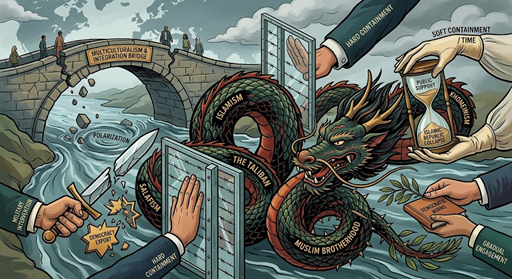
This is the second post in a short series that maps the ideological landscape of Islamism and explains how it has influenced Western politics over the past few decades to provide context for anyone trying to understand today’s political landscape in the West—with its growing internal tensions, cultural conflicts, and ideological battles. And of course, this discussion would be incomplete without addressing Israel’s place and role within this confrontation.
Part 1: Islamism: a Multi-Headed Dragon
Despite how emotional debates about Islamism have become in recent years in the West—especially in politics—this is not a new concern. Western governments were already deeply worried about it decades ago and, over the past 30 years, have tried various strategies.
One of the most well-known examples is the attempt by President George W. Bush to export democracy to the Middle East—through military interventions in Iraq and Afghanistan, and even an effort to promote democracy in the Gaza Strip, where Hamas (the Palestinian branch of the Muslim Brotherhood) won the first and last Palestinian elections in 2006.
When these efforts failed to establish stable democracies—and instead contributed to the spread of jihadism—they also led to the emergence of a wide range of approaches in the West. These approaches attempt to address the challenge both in a more granular way (by distinguishing between different Islamist movements) and in a broader, more holistic way.
Addressing Salafism
Because of its strong link to violence, the West has focused on fighting the militant wing of Salafism (such as al-Qaeda and ISIS). This campaign has had partial success, mainly in the Middle East, where a global coalition defeated ISIS as a territorial entity in Iraq and nearby areas. However, both ISIS and al-Qaeda have continued to spread like a social cancer across parts of Africa, the Middle East, and South Asia.
Addressing the Taliban
The main Western approach to the Taliban today has been isolation and “hard containment”—applying pressure to limit its influence and push for change. Since the Taliban is primarily a nationalist-religious movement (focused on ruling Afghanistan under its own version of Sharia, rather than spreading a global Islamic order), most Western countries broadly agree on this strategy.
Addressing Khomeinism
Western governments have no illusions about the nature of Iran’s Islamist system. However, their main strategy has effectively been one of “soft containment”—buying time. The logic behind this approach is that, over time, public support for Islamism would decline, and that an ideology which must constantly expand in order to survive would eventually collapse under its own weight.
And indeed, there is some evidence of the policy’s success: today, more than 70% of Iranians oppose the continuation of the Islamic Republic—a striking contrast to the near-total support (98.2%) shown in the 1979 referendum.
Still, despite economic failure, declining public support, and the broader failure of the top-down Islamist model, the regime’s leaders have not lost faith in their objectives. However, as their current path appears increasingly exhausted—and as confrontation with the outside world becomes more difficult to avoid—the regime seems to be turning toward violence as a way to facilitate its transformation.
This pattern—turning to violence when internal growth stalls—has shown up in other cases as well, such as the breakdown of negotiations at Camp David in 2000 and Hamas’s actions on October 7, 2023.
If this is indeed the internal logic of the IRGC, then negotiations between the United States and the Islamic Republic may have limited value. The regime may view conflict itself as a tool—to reset conditions and rebuild momentum.
This leaves the West with a difficult choice: either dismantle Iran’s military capabilities, including its supporting industrial base—risking backlash and further radicalization within the Shia population—or preserve that infrastructure and risk another round of escalation in the coming years.
Addressing the Muslim Brotherhood
The Muslim Brotherhood has one of the largest social support bases among Islamist movements. It has tens of millions of supporters across countries like Egypt, Turkey, Jordan, Qatar, Tunisia, Kuwait, and among Palestinians, and influence in around 70 countries, including a noticeable footprint in Europe.
Its strategy is gradual and bottom-up: changing society over time rather than through immediate revolution. No rush. No single dramatic moment. Just steady, long-term transformation.
And that’s exactly where the Western dilemma begins. One school of thought argues: if the Brotherhood plays the long game, so can liberal societies. Over time, exposure to open systems, economic development, and democratic norms might moderate its base. In this view, Islamism can be softened—not crushed.
The opposing view is far less optimistic. It argues that demographics and persistence matter more than ideals. A movement that already has tens of millions of supporters doesn’t need to “win” overnight—it just needs to keep growing. And there is no built-in guarantee that liberalism will prevail in the long run.
History adds to the concern. The Brotherhood’s track record suggests that gradualism does not necessarily lead to moderation. In some cases, it leads the other way. The Palestinian branch, for example, spent decades building social influence—only to eventually transform into Hamas.
So the real question isn’t just what the Muslim Brotherhood is today. It’s what it becomes over time—and whether gradual change leads to integration… or to something much harder to contain.
Addressing the Muslim World More Broadly
In Europe and the United States, a key idea over recent decades has been to avoid a direct “clash” with the Muslim world. The solution? Build a bridge.
That bridge was constructed on the principles of multiculturalism, diversity, and a willingness to acknowledge past colonialism. Millions of Muslim immigrants came to Europe through this “bridge” and were largely welcomed. Many integrated successfully, adopted liberal democratic values, and became part of the social fabric. But not all.
Polling data across Europe points to a deeper identity divide beneath the surface. For example, one UK survey found that 23% of British Muslims support the introduction of Sharia law. In France, studies suggest that a large majority (around 80%) identify strongly with religion, and one in three Muslims (33%) expresses sympathy for at least one Islamist movement, with the number rising to 42% among those under 25. Similar patterns appear in countries like Germany and the UK.
As a result, many Europeans are now questioning whether this “bridge-building” policy has succeeded or failed. Several things are becoming clear:
- It is a high-risk strategy with no guaranteed success and, given current trends, may be moving in the wrong direction.
- It is difficult to reverse. Stopping now is like stopping in the middle of a river. After bringing in tens of millions of immigrants, it is very hard to change course and focus inward without alienating even the loyal and well-integrated parts of Muslim communities in the West.
- It requires weakening parts of the national “immune system” to absorb new populations, which can leave societies and the political system exposed.
This has led to growing political polarization. Some support continued openness and integration (“the bridge”), while others advocate stricter borders and stronger pushback. Between these positions lies a weakened political center, trying to balance both approaches and constantly recalibrate them in response to changing circumstances in a pragmatic way.
Conclusion:
One of the core divides in Western politics today comes down to a single question: how do you deal with Islamism?
On one side, left-leaning approaches tend to use force only against the most extreme and openly violent groups, and handle everything else through engagement, integration, and “soft containment.” The assumption is that, over time, societies converge, and moderation wins.
On the other side, right-leaning approaches are more skeptical of that bet. They tend to be cautious toward all strains of Islamism and they are less willing to rely on risky, long-term social experiments and more inclined to use pressure—and, where necessary, force—earlier and more broadly.
This divide—combined with broader questions about identity—has become one of the defining features of Western political debates today.