

By Ron Raskin.
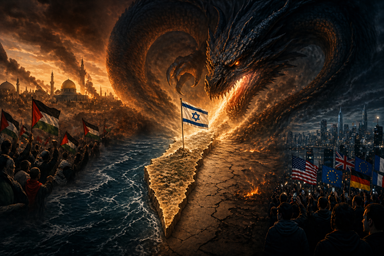
This is the third and final post in a short series that maps the ideological landscape of Islamism and explains how it has influenced Western politics over the past few decades to provide context for anyone trying to understand today’s political landscape in the West—with its growing internal tensions, cultural conflicts, and ideological battles. And of course, this discussion would be incomplete without addressing Israel’s place and role within this confrontation.
Part 1: Islamism: a Multi-Headed Dragon
Part 2: Taming the Dragon: How the West Confronts Islamism
As I wrote in the previous post, most modern Western ideologies are built around one main question—how to deal with the clash of civilizations. And within that, the clash with the Muslim world, especially with the rise of Islamism, may be the hardest and most dangerous challenge the West faces today. Israel, which is right on the front line of this clash, is in a unique position where everything it does—or doesn’t do—has a direct and immediate impact on both sides. That’s why it’s not surprising that what is often described as a century-long conflict between two small nations, somewhere at the edge of the world—Israel and Palestine—appears so often on the front pages of Western media, sometimes even more than a war in the heart of Europe.
Long before October 7th, different Western ideologies were already in a kind of “cold war,” pushing their narratives within their own societies, quietly preparing and building more advanced tools for information and narrative battles. On October 7th, that long period of quiet preparation ended, and these ideological camps moved into a more open kind of conflict—an information war where, like in most wars, each side is ready to use whatever means it thinks are necessary.
Israel in the eye of the storm:
As in any battle description, we start by looking at the initial positions of the different ideologies and then move to their maneuvers.
All sides understand Israel’s unique position—a foothold of democracy in the Middle East. Islamism uses this position by turning Israel into a common enemy to build unity around it. Nothing unites people more than a hatred to the shared enemy, and in this case, Islamism has found in Israel—close, yet detached from its democratic allies both geographically and culturally—a convenient target.
Of course, this has not gone unnoticed by Western ideologies, which have had to decide their attitude toward Israel. Consequently, many Western center and center-left ideologies that believe the best way to deal with Islamism is through soft containment—in other words, by putting as little pressure as possible on Muslim populations in order to avoid strengthening unity—therefore prefer Israel to keep as low a profile as possible. They recognize Israel’s right to self-defense, but in their view, that defense should be as limited as possible. This is often what is meant by the phrase “Israel’s disproportionate response”: the idea that Israel should defend itself against attacks without putting real pressure back on the attacker, even if this leads to increased military risk, ongoing losses, and even long-term danger to Israel’s survival—a kind of “punching-bag” policy. To enforce this, they are sometimes willing to use restrictions on military supply and other political measures to ensure Israel’s compliance.
But avoiding pressure on the Islamic world is not their only challenge. Immigration, which is meant to serve both as a demographic tool and as a bridge between civilizations, is also a key part of their approach. On one hand, in a zero-sum competition for sympathy between two rival sides, these ideologies tend to favor the Muslim side to ensure better integration. On the other hand, they must also deal with large political demonstrations—often with strong participation from Muslim communities—directed against Israel. This raises a difficult question: how do you explain to your electorate that immigrants you brought are chanting “From the river to the sea…”—a slogan some interpret as a genocidal call against Jewish democracy? How do you hide that you brought millions of jihadists to your own land by your own hands?
The solution is rather simple: you rebrand these jihadists as human rights defenders. That, of course, also requires rebranding Israel from a democracy under attack into a villain nation that disrespects human lives.
Such rebranding can also serve another purpose: if Israel were ever to face defeat, it provides Western nations an alibi for why they did not intervene more directly or send their own soldiers to fight and die in support of an ally, despite past commitments to “never again.”
While the center and center-left still try to balance their interests with their moral obligations, the far left does not see moral constraints as necessary and goes one step further: no Israel, no common enemy for Islamism to unite around. Apparently believing that sacrificing Israel is worth a chance to prevent conflict and save numerous lives. But beyond the moral concerns, this approach also overlooks historical lessons—such as Munich in 1938, Crimea in 2014, and Israel’s withdrawal from Gaza in 2005—which suggest that concessions to aggressors often lead to more aggression, not less.
So far, we have reviewed the reasoning of the “bridge-building” camp. The logic and approach of the “build a defensive wall” camp are, of course, different and largely depend on where each ideology within this camp believes the wall should be drawn.
While center-right and right-wing ideologies tend to define the wall along civilizational lines—often including the broader “West,” and therefore Israel within it—the far right prefers to draw the boundary around national or race-based identity. As a result, it often excludes Israel, viewing it as an unnecessary burden.
In addition to the reasoning outlined above behind contemporary Western ideologies, there are, of course, other factors shaping their relationship with Israel. These include hostility within parts of the growing Muslim population, as well as the influence of external campaigns by countries such as Qatar, Iran, Russia, and China, which seek to divide the West.
However, it is important to emphasize that these factors alone cannot account for the consistent and deliberate omission of facts—and, at times, their distortion—in many Western outlets, which are well aware of the facts and the historical context, and are influenced by Western elites while serving Western ideological frameworks. Nor can classical antisemitism fully explain this, as many of these ideologies, on the one hand, promote hostility toward Israel (effectively creating a new form of antisemitism often described as anti-Zionism), while on the other hand they “love” Jews.
These factors are therefore not the primary drivers of hostility toward Israel. Rather, internal ideological struggles within the West play the central role, and attitudes toward Israel often serve as a revealing indicator of an ideology’s deeper vision.
Connecting the dots:
Understanding the current unrest in the West, its culture wars, and its ideologies without considering the real dangers coming from the clash of civilizations—and the different interests of the groups involved—is simply impossible. Only when you put aside “rose-tinted glasses”, look at reality as it is, and start to understand the real intent behind the slogans around us does the picture begin to make sense. And only then does the real meaning of the political battles in the West around Israel—the point where two civilizations meet—become clearer.
Yes, unfortunately, the world can be very cynical: “Countries don’t have friends, only interests” (Charles de Gaulle). Modern Western ideologies show another lesson in this cynicism: any set of values, ideology, or media system that gains a high level of trust can eventually be used or manipulated. Today, liberal values—which have become a vehicle for many ideological narratives in the West—are being used in this way.
Which, of course, leads to a natural question: what are the implications of this for liberalism? Can it survive what some would call the “great betrayal” of Israel and its own values? And will Israel—believing itself to be part of the West, yet feeling betrayed—be able to forgive the West? Could Jewish citizens of Germany, who at the beginning of the 20th century believed they were fully part of German society, forgive Germany for what their fellow citizens did to them during World War II? One thing is certain—the world will not be the same again.
Summary:
The level of precision with which we understand reality, in all its complexity, is not just an academic exercise. It is what separates good strategy from bad strategy, good solutions from bad ones, and ultimately success from failure. Oversimplifying even slightly can lead to disaster—or worse, to ending up on the wrong side of history. And without understanding the role of Israel and how Western ideologies relate to it, such an understanding can never be complete. I hope this series of posts has helped bring a bit more clarity to what is really happening in the world today.