

By Ron Raskin.
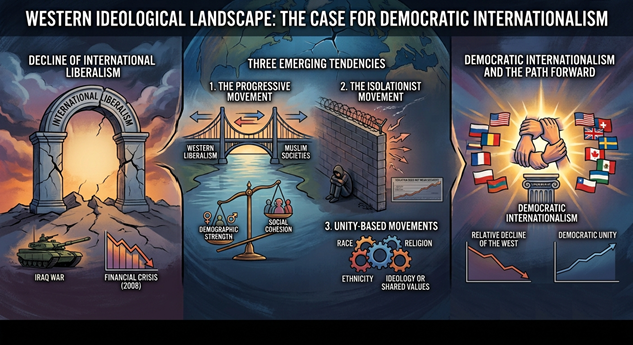
30 years ago, the mainstream Western ideology—the dominant Western consensus—was international liberalism: spreading democracy and human rights abroad.
But the “end of history” never really happened. One major blow to this idea—or, more precisely, to its more hawkish versions, such as neoconservatism—came with the Iraq War. Then, in 2008, the financial crisis dealt another serious blow to globalization, a system deeply intertwined with international liberalism and often seen as a vehicle for extending Western influence and, indirectly, liberal democratic values.
One of the first/the more prominent American politicians to recognize that trying to spread democracy (or export democracy – choose your favourite wording) could backfire was Bernie Sanders.
Today, international liberalism is in deep decline, and so is the political center across the West political landscape. The space once occupied by international liberalism is now increasingly being filled by three broad ideological tendencies (with all their overlaps):
1. The Progressive movement
The progressive approach essentially says: let’s avoid a clash of civilizations, especially a clash with the rapidly growing Muslim civilization part of which is influenced by Islamist political movements, by building a bridge between Western liberalism and Muslim societies—adapting Western liberalism and its values to accommodate Muslim populations and their values. A middle ground between the two.
Twenty years ago, this could have seemed like an interesting and potentially promising approach. But after two decades of experience, it is becoming increasingly difficult to ignore the possibility that it is not producing the intended results.
The problem is not necessarily the idea of building bridges itself. It is that any tool—including a bridge between societies—has to be used appropriately. You don’t use a hammer to fix a watch.
A bridge enables movement in both directions. That raises a fundamental question: Which side will exert greater influence on the other? And the answer is likely to be: toward the society with more energy from the society with less energy.
In other words, when two societies are connected, the exchange is not necessarily symmetrical. Demographics, identity strength and social cohesion can all affect which side has more influence over the other.
2. The Isolationist movement
The isolationist approach sees the solution more simply: stay aside, build a wall, and wait until the storm is over.
The problem is that seas or nuclear capabilities are not really the barriers they once were. You don’t necessarily need to send tanks into a Western country to make it surrender. You can cut its economic channels, disrupt its critical systems, terrorize its population, exploit internal divisions, and simply wait for the society to weaken or collapse from within.
In the 21st century, isolation does not necessarily mean security.
3. Unity-based movements
The third direction is based on some form of unity, and that unity can be based on almost anything: race, religion, ethnicity, ideology, or shared values.
If Western societies in the post-international-liberalism era, want a basis for unity that avoids race, ethnicity, religion, or traditional nationalism, democratic internationalism may offer the most natural alternative
Of course, this is difficult to achieve, especially given the deep trust issues between Western nations. But there is another factor that could push them in that direction: external pressure. External pressure can create an incentive for democratic nations to cooperate more closely and foster unity.
Unfortunately, the relative decline of the West is real—demographically, economically, and in terms of its share of the world’s population and economy. As a result, changes in the distribution of global power and in the world order are inevitable.
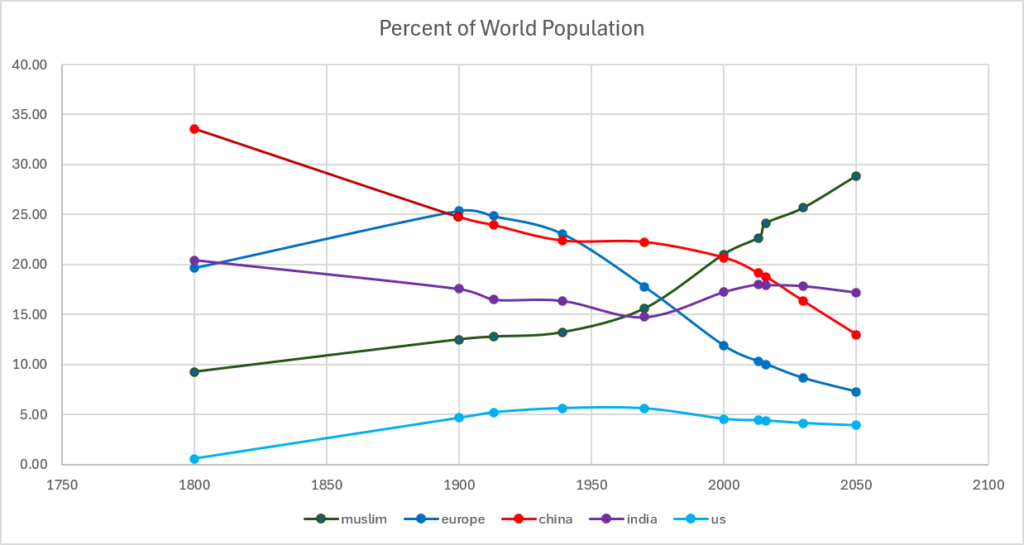
And the clash of civilizations is not simply another intimidation tactic. It is real, and we are already in the middle of it. That is one reason we are seeing so much tension and polarization inside Western societies. That is also why we see strong leaders emerging who promise to protect their nations and make them “great again.”
And that is why we should put democracy at the center—both literally and ideologically.